

In short
Gross profit is what buyers paid, less every cost on the page. Net profit is gross profit less the costs you added yourself. Say you sell 5 blenders in one day. Buyers pay $20 each. Each one cost you $8. Amazon takes $8 in fees on each one. One sale has a $2 coupon, and one buyer sends a blender back.
With no expenses that day, Net profit is $7.00 too.
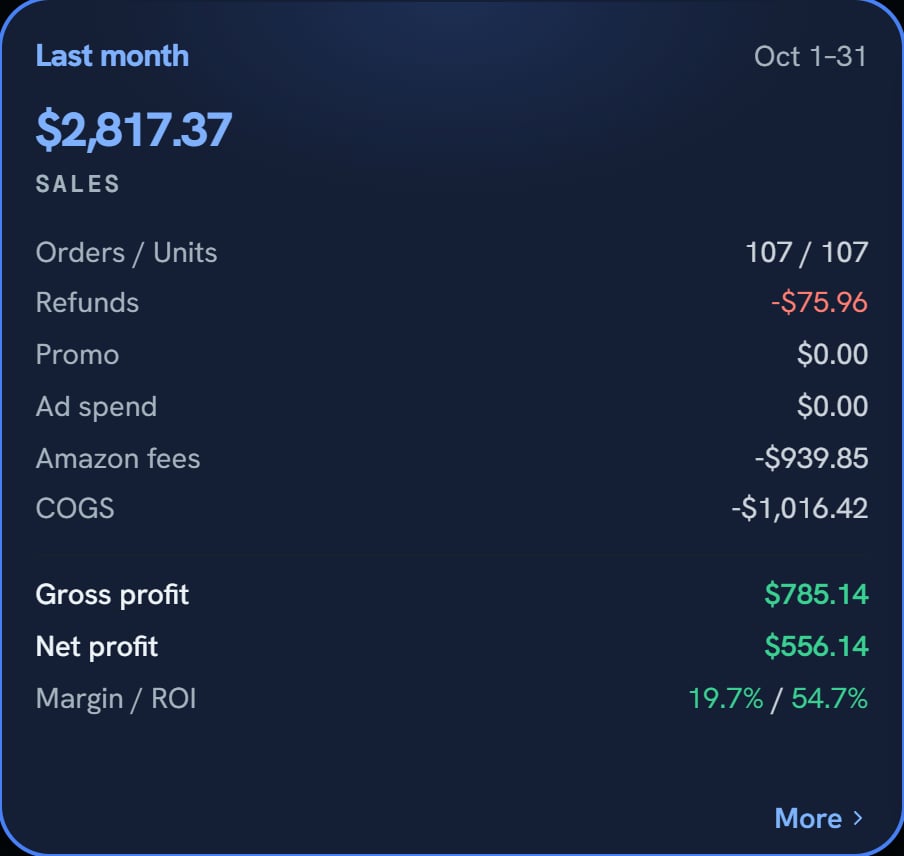
The demo store's Last month tile. Notice each line the table above explains, from Sales $2,817.37 down to Net profit $556.14.
More details
What each line means
What each line means
- Orders: Amazon orders placed in this period. An order with two products counts once on the tile.
- Units: units buyers ordered in this period. Cancelled units are left out.
- Sales: what buyers paid. Once Amazon pays an order, it’s Amazon’s paid-out amount. Before that, it’s the order price.
- Promo: discounts on these orders, like coupons and deals.
- Refunds: refund cost in money, by refund date, less the fees Amazon gave back. Units sent back in good shape add their cost back.
- Ad spend: Amazon gives one ad total per product per month. SourceDock spreads it evenly over the month’s days.
- Amazon fees: Amazon’s fees for these orders, plus inbound, storage, removal, and disposal fees, less what Amazon paid you for lost or damaged units. See Amazon’s fee lines.
- COGS (cost of goods sold): what the sold units cost you, from your purchases. It also holds units Amazon lost or damaged, and box charges. It’s the same cost Capital Recovery uses.
- Gross profit: sales less promo, ad spend, refunds, Amazon fees, and cost of goods.
- Net profit: gross profit less the costs you added on the Expenses page.
One refund has four parts
One refund has four parts
-$20 - $1 + $3 + $8 = -$10. That’s the Refunds line.COGS still counts all 5 units, the returned one too. Its $8 comes back inside the refund. In profit, the two cancel out for that unit.
Which day each thing counts on
Which day each thing counts on
A sale counts on the day the buyer ordered it. A refund counts on the day Amazon posts it.Value of returned items counts on the day Amazon’s returns report says the unit came back. Say that’s a month later. This month shows -$18, and next month shows +$8.
Margin and ROI
Margin and ROI
On a tile, these two share one line, Margin / ROI.Margin is net profit divided by sales. $7 / $100 = 7.0%.ROI is net profit divided by what the sold units cost. $7 / $40 = 17.5%. If the cost is $0, ROI is a dash.
When you add an expense
When you add an expense
Say you record $8.00 for boxes and tape, one time, on this day. It counts in full on that day. Net profit is $7 - $8 = -$1.00, and that bar on the chart is red. Gross profit stays $7.00. The $8 isn’t in the payout either, since you paid it outside Amazon.The product’s own row doesn’t carry it. It sits on the Store fees (no product) row. See Write-offs and expenses.