

In short
See details → on an open row opens the side panel. Its LEDGER tab starts with what buyers paid, takes off each cost, and ends at Net Profit. You have your money back once that line reaches $0. Say buyers paid $180.00 for your toy trucks, and you paid $120.00 for all 10. After Amazon’s fees, ads and a refund, Net Profit reads -$6.00, because 3 trucks are still unsold.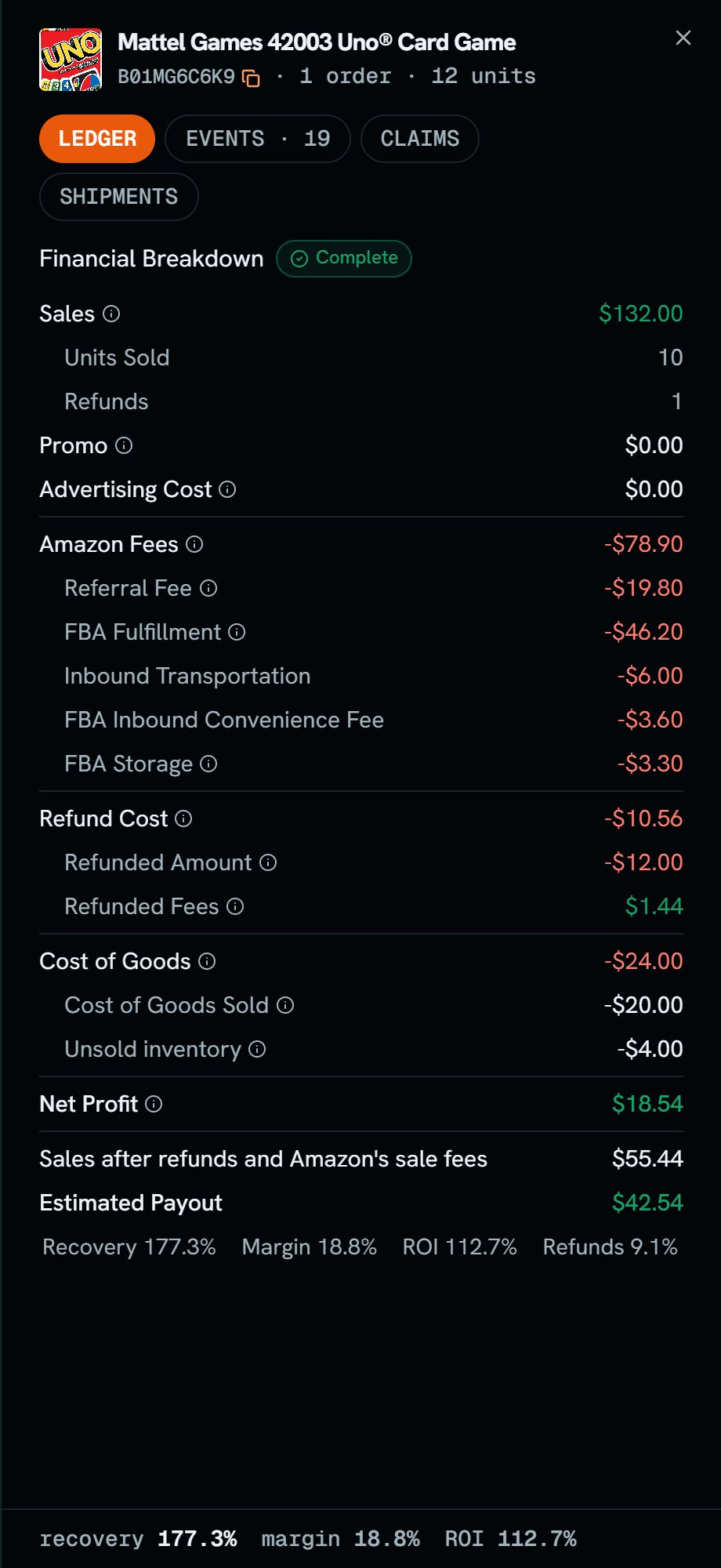
Uno card game: See details, then LEDGER. Notice Sales $132.00, Net Profit $18.54 and Estimated Payout $42.54, with the four percents at the bottom.
More details
The tabs
The tabs
- LEDGER is the product’s Financial Breakdown. If SourceDock doesn’t know what you paid, the title says Cost unknown. Add the buy cost in Purchases.
- EVENTS lists every Amazon event for the product. Click Sales, Fees, Refunds, Returns, Losses, Damages, or Reimb. to see one kind, or All.
- CLAIMS lists what Amazon may owe you. See Claims.
- SHIPMENTS lists your shipments to Amazon.
How sure the numbers are
How sure the numbers are
A badge on the ledger says how sure they are.
- Complete: Amazon sent a record for every unit sold, so these are Amazon’s own numbers.
- Partial: some older sales use Amazon’s monthly totals.
- Estimated: no record for each order yet, so the numbers come from monthly totals.
- Updating: new records are still coming in. They update by themselves.
Sales, Promo and ads
Sales, Promo and ads
The example is the red toy truck.Sales is $180.00: what buyers paid for the product itself. Tax and shipping aren’t in it. A refund isn’t taken out here, since it has its own line below. Under it, Units Sold counts units that stayed sold, and Refunds counts refunds.Promo is money you took off the price, like a coupon you funded. A discount Amazon pays for is left out.Advertising Cost is -$4.00: what you spent on Amazon ads for this product. While no month of ad cost has come in, it reads -, never $0.00. With some months still coming, it shows what has come in, and Net Profit leaves the rest out. Only when the ad numbers could not be read at all does Net Profit show - too.
Amazon Fees
Amazon Fees
Amazon Fees is -$60.00: everything Amazon charged on the sales. Referral Fee and FBA Fulfillment always show when there are sales. Other fee lines, like storage and inbound shipping, hide at $0.00.
Reimbursements and Refund Cost
Reimbursements and Refund Cost
Reimbursements is $18.00: money Amazon paid you back, here for a lost truck.Refund Cost is -$20.00: Refunded Amount handed back to the buyer, -$30.00, plus Refunded Fees Amazon gave back, $10.00.Store refunds, Orders you shipped yourself, and Shipping labels show only when they aren’t zero.
Cost of Goods
Cost of Goods
Cost of Goods is -$120.00: what you paid for every unit you bought, sold or not.
Under the lost line, a note can say how much of it Amazon hasn’t paid back yet. That note isn’t subtracted again.Unsold inventory can differ from Stock at Amazon at the top of the page. A returned truck counts as sold here, because a buyer did buy it. The top counts it as stock, because Amazon put it back on sale.
Net Profit and Estimated Payout
Net Profit and Estimated Payout
Net Profit matches the row’s P&L: $180.00, minus $4.00 ads, minus $60.00 fees, plus $18.00 reimbursements, minus $20.00 refund cost, minus $120.00 cost of goods, is -$6.00.Estimated Payout is $118.00, the same as the row’s Recovered. The ad doesn’t come off it, since it already came off Net Profit. A second line named Recovered shows only when the two differ, which starting stock with no cost can cause.
The four small percents
The four small percents
- Recovery is the payout divided by what you paid: 98.3%.
- Margin is 20.0%, and ROI is 35.7%. They match the row, to one decimal.
- Refunds is what you handed back, divided by sales: 16.7%.